NYC Will Pay for Your Job Training: Free Queens Sessions This October
Published: September 22, 2026 | By LocalJobPage Team
NEW YORK, NY — The cheapest way to change careers in this city right now is not a bootcamp ad on the subway. It is a Tuesday morning in Forest Hills, a folding chair, a photo ID and a skills test that takes about two hours. New York City's Individual Training Grants program covers tuition, registration, books and testing fees for short-term job training, and three information and assessment sessions are on the Jobs NYC calendar for October, all of them in Queens.
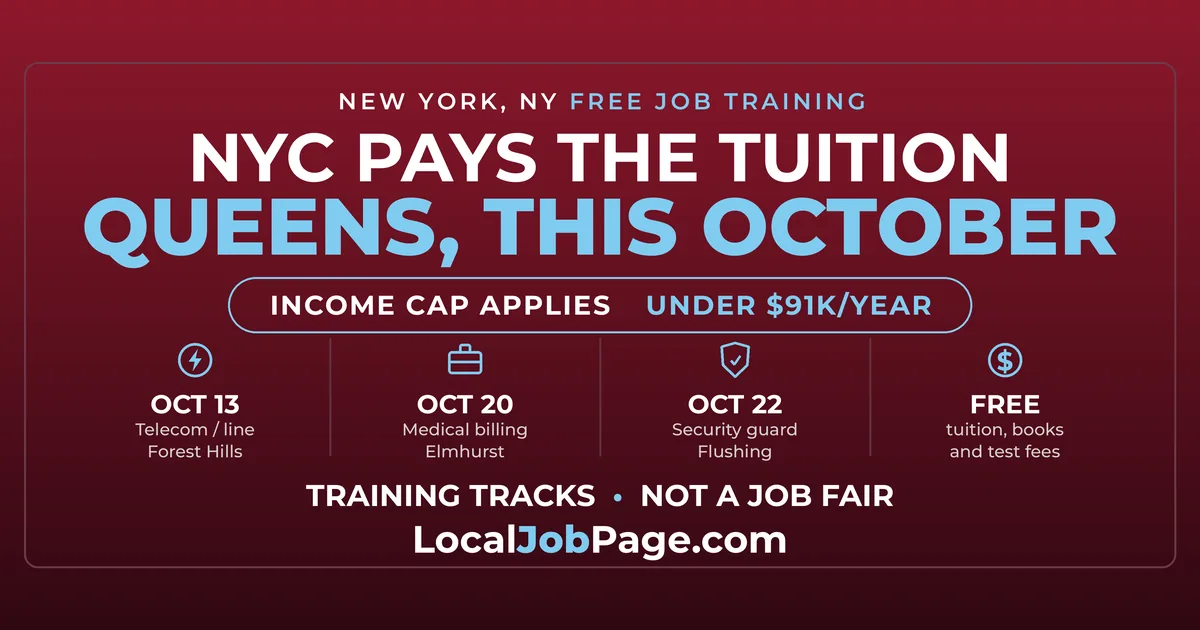
Three free, federally funded sessions run between October 13 and October 22, covering telecommunications line work, medical billing and coding, and unarmed security guard certification. Every one of them is free, and every one of them has an income line that decides who walks out with a seat.
Need work now? Skip to the job links and start searching the same fields today →
📅 Table of Contents
- October 13 — Telecommunications and Line Installer Training
- October 20 — Medical Billing and Coding Training
- October 22 — Unarmed Security Guard Training
Telecommunications and Line Installer Training — Tuesday, October 13
9:30 a.m. | Telecom Institute of New York, 117-14 Queens Blvd, 2nd Floor, Forest Hills
This is the track for people who do not want a desk. Line installers and telecom technicians pull fiber, climb, splice and troubleshoot the physical network that every other job in this city quietly depends on, and the work does not offshore. The session runs out of a storefront school on Queens Boulevard a short walk from the 71st Avenue station, which makes it one of the easier addresses on this list to reach from almost anywhere on the E, F, M or R. The city's listing pairs the training with job placement help from Workforce1 staff after the course ends. The official event page carries the registration form.
Medical Billing and Coding Training — Tuesday, October 20
9:30 a.m. | ACE Institute of Technology, 40-42 75th Street, Elmhurst, NY 11373
Elmhurst is the right zip code for this one. The neighborhood sits inside one of the densest clusters of hospitals, clinics and specialty practices in the five boroughs, and every one of them runs on people who can read a chart and turn it into a clean claim. Medical billing and coding is the classic side door into a health system for someone with no clinical background and no four-year degree. Bring a valid ID; the city's listing says to plan for an assessment that can take up to two hours. The provider lists a phone number, 718-575-3223, and accommodation requests go to training-02@sbs.nyc.gov. Details are on the official event page.
Unarmed Security Guard Training — Thursday, October 22
9:30 a.m. | Empire Security & Protection, 7064 Kissena Blvd, Flushing, NY 11367
Security is the fastest of the three to turn into a paycheck, because the state licensing ladder is short and well marked. New York registers guards through the Department of State, and the entry requirement is an 8-hour pre-assignment course, followed by 16 hours of on-the-job training within 90 days of being hired and 8 hours of in-service training every calendar year after that. All of it has to happen at a school approved by the state's Division of Criminal Justice Services. Flushing is a sensible place to start it, with hospital campuses, retail corridors and office towers within a few miles in every direction. Registration runs through the city's event listing.
💵 What the Grant Actually Covers
An Individual Training Grant is not a loan and not a stipend. According to the city's own program page, it funds course tuition, registration fees, testing fees and books for short-term training that runs under a year. It does not fund college credit courses, and it does not put money in your pocket for rent while you study. The city describes the award process as selective rather than automatic: you are assessed on eligibility, skills, experience and how likely you are to land work at the end.
The city's published FAQ puts the full application at roughly four to six weeks, start to finish, across six steps that include a skills test, an online application, a letter from the training provider and an interview with a career advisor. That timeline matters. If you show up October 13 expecting to be in a classroom October 14, you are going to be disappointed. Showing up in October to be training by winter is the realistic version.
⚠️ Who This Is NOT For
These sessions have real gates, and they are worth reading before you give up a morning.
- You need to be 18 or older with a high school diploma or GED.
- You need to be authorized to work in the United States.
- You need to be actively looking for work, and willing to report back once the course lands you a job.
- You need to be registered with Workforce1 before you attend. That is the step most people miss.
- There is an income ceiling. The listings for all three October sessions, and the city's ITG FAQ, state that applicants must earn under 91,000 dollars a year.
One honest caveat on that last point: a separate city page describing the same program lists a lower income figure. We could not reconcile the two from published sources, and eligibility here is confirmed by a career advisor rather than by a web page. If you are anywhere near either line, call your Workforce1 center and ask before you count yourself out. Nobody has ever been turned away for asking.
🔎 How to Pick the Right One
- You want out of retail and into a trade: October 13, telecom. Physical work, real equipment, and a skill set that stays local.
- You want into a hospital without clinical training: October 20, medical billing and coding. Elmhurst, Jackson Heights and Corona alone employ thousands of people doing this work.
- You need income soonest: October 22, security. The state licensing path is the shortest of the three, and the sector hires year round across all five boroughs.
- You are not sure yet: register with Workforce1 this week regardless. It is the prerequisite for all three, and it costs you nothing but an afternoon.
📋 What to Bring to Any of Them
- A valid photo ID. Non-negotiable at all three.
- Proof of your high school diploma or GED if you have it on hand.
- An updated resume. The city's program page names this outright.
- Two clear hours. Assessment testing is part of the morning, not a formality after it.
- Your Workforce1 registration, done in advance.
Where to Aim While You Wait
Four to six weeks is a long time to sit still, and none of these three fields require you to wait for a grant to start applying. Plenty of New York employers train security guards, billing clerks and field technicians on their own dime. For context on what this market pays, workers across the New York-Newark-Jersey City metro area averaged 41.50 dollars an hour in May 2025, according to the U.S. Bureau of Labor Statistics. Entry-level roles in these three fields start well below that, but they start, and they start now.
Start here:
- Security guard jobs in New York, NY
- Medical billing jobs in New York, NY
- Medical records jobs in New York, NY
- Patient access representative jobs in New York, NY
- Fiber optic technician jobs in New York, NY
- Cable installer jobs in New York, NY
- Telecommunications technician jobs in New York, NY
- Allied Universal jobs in New York, NY
- Northwell Health jobs in New York, NY
- Charter Spectrum jobs in New York, NY
Frequently Asked Questions
Do these October sessions cost anything?
No. All three are listed as free, and the Individual Training Grants program is federally funded. The grant itself covers tuition, registration, testing fees and books for the course that follows.
Do I have to live in Queens to attend?
No. The sessions happen in Forest Hills, Elmhurst and Flushing, but the program serves New York City residents citywide. Pick the date and the field, not the borough.
Can I just walk in?
Each of the three listings points to its own registration form, and all three require Workforce1 registration beforehand. Treat these as register-first events rather than walk-up hiring halls.
Is this a job fair?
No, and that distinction matters. Nobody is hiring on the spot at these. They are information and assessment sessions for a training grant, with job placement help from Workforce1 after the course ends.
How long until I am actually working?
The city's published FAQ puts the application at four to six weeks, and the training itself runs under a year by program rule. Security is typically the shortest path of the three; telecom and medical coding take longer.
Will this guide be updated?
Yes. City training calendars turn over monthly and sessions get added, moved and filled. We update this page as the Jobs NYC calendar changes, so check back before you plan a trip.
Line Up the Grant and the Job Search at the Same Time
The smartest version of this plan runs on two tracks at once: register with Workforce1, claim a seat at whichever October session fits, and keep applying in the meantime. Create your free LocalJobPage account to save searches and get New York City openings as they post, and browse the Career Center for role-by-role guides in the fields these programs feed.
Employers: if you are hiring entry-level technicians, billing staff or guards in the five boroughs, post your openings on LocalJobPage and reach New Yorkers who are already training for the work.
Related Reading
- New York City Job Fairs, Sept. 24-30: Hiring Halls in Brooklyn and Staten Island
- New York City's Civil Service Door Is Open Right Now
- Administrative Assistant Jobs in New York
- Customer Service Representative Jobs in New York
Queens Boulevard on a Tuesday morning is not where most people picture a career starting. But the 117-14 storefront, the Elmhurst classroom off 75th Street and the Kissena Boulevard office are three of the shortest distances in this city between where you are and paid work, and for the next month the city is covering the tuition.